StoryWright
Offline Story Bible Software for Writers
Your competitive moat, in plain terms.
Notion runs $16 a month. Scrivener is a $60 one-time hit that still leaves you building your own continuity system from scratch. Spreadsheets are free and fall apart the moment your series clears book two. StoryWright is $15, once. No subscription, no price creep, no “we’re pivoting to AI” email six months from now.
Most writing tools also want an internet connection and a cloud account, which means your unpublished manuscript and series notes live on someone else’s server. StoryWright runs entirely offline in your browser. Nothing you write ever leaves your machine — no account to create, no sync to trust, no breach to worry about.
And unlike a productivity tool retrofitted for fiction, StoryWright was built for series writers from the ground up. It’s genre-aware, so a romance writer never wades through spaceship fields and a sci-fi writer never sees fields meant for a regency ballroom. Every module — characters, factions, chain of command, magic systems, world history — only shows up when your genre actually needs it.
It also does the things spreadsheets and Notion templates can’t touch. The Consistency Report flags the stuff every series writer eventually gets burned by — a character’s eye color that changed between books, a rank that doesn’t match your chain of command, a species trait you contradicted four books later. Global Search and Find & Replace mean you’re never scrolling through a 40-page document hunting for the one scene where you named a planet.
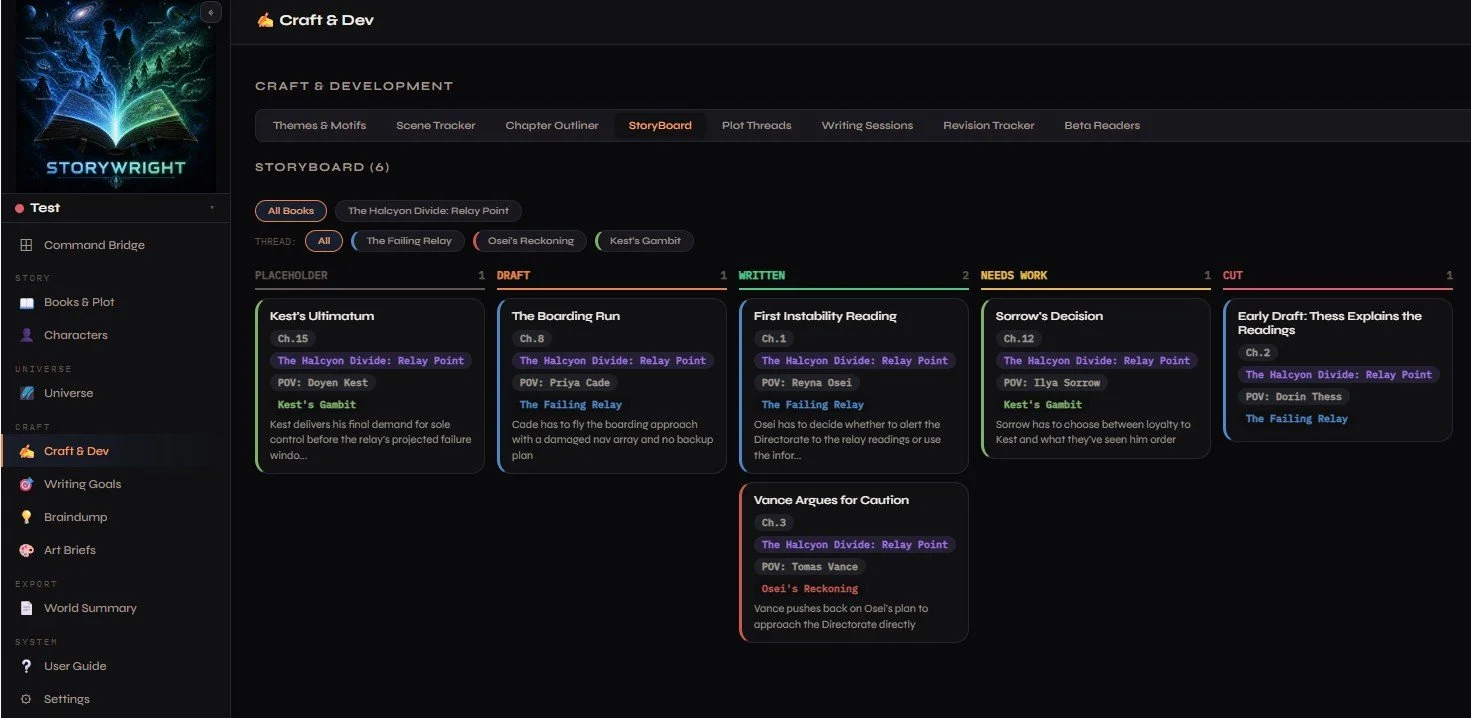
Now it goes further than tracking facts — it tracks the story itself. StoryBoard gives you a drag-and-drop scene tracker, five columns deep, Placeholder through Cut, so you can see your whole manuscript’s shape at a glance instead of scrolling a linear outline. Click a card and you’re editing status and stakes in seconds — no digging through a full form for a quick check-in.
And Plot Threads keep your throughlines honest. Color-code a thread, tag your scenes, then filter down to just that one and watch it play out scene by scene — the exact check you need before a subplot goes quiet for six chapters and nobody notices until an editor does.
It also includes a full submission tracker — not just for literary agents, but for magazines, contests, and anthologies too, with direct CSV import from QueryTracker.net. Notion, Scrivener, and spreadsheets were never built to do that, because tracking submissions was never their job.
In short:
• Cost — $15 once, vs. $16/month or more for the alternatives
• Privacy — fully offline; nothing leaves your machine
• Built for fiction — genre-aware, not a repurposed productivity tool
• Self-checking — the Consistency Report catches contradictions before your readers do
• Story-aware — StoryBoard and Plot Threads track your scenes and throughlines, not just your facts
• Submission tracking — agents, magazines, contests, and anthologies, built in, not bolted on
Built by a writer. For writers.
StoryWright was built by J. Hawkens — author of Earth Unbound and The Aethermoor Chronicles — to manage his own series. It’s not a generic app retrofitted for fiction. It’s the tool the author actually uses to run his own worlds, book to book, character to character, scene to scene.
Built for writers who:
• Are managing a series and terrified of continuity errors
• Are actively querying agents — or submitting to magazines, contests, and anthologies — and need to track it all without losing their minds
• Have worldbuilding notes scattered across a dozen documents
• Don’t want their unpublished manuscript sitting in someone else’s cloud
• Want to see their whole manuscript’s shape, not just scroll it
Built by a writer. For writers.
StoryWright was built by J. Hawkens — author of Earth Unbound and The Aethermoor Chronicles — to run his own series, book to book, character to character, scene to scene. It's not a generic app retrofitted for fiction. It's the tool the author uses himself, every day, on the same worlds you're reading this to build for your own.
Built for writers who:
Are managing a series and terrified of continuity errors
Are actively querying agents — or submitting to magazines, contests, and anthologies — and need to track it all without losing their minds
Have worldbuilding notes scattered across a dozen documents
Don't want their unpublished manuscript sitting in someone else's cloud
Want to see their whole manuscript's shape, not just scroll through it
One file. Offline. Private. Yours forever.
StoryWright is a complete series bible that runs entirely in your browser — no account, no internet connection required, no server reading your story. Open the file, and everything you've built is right there.
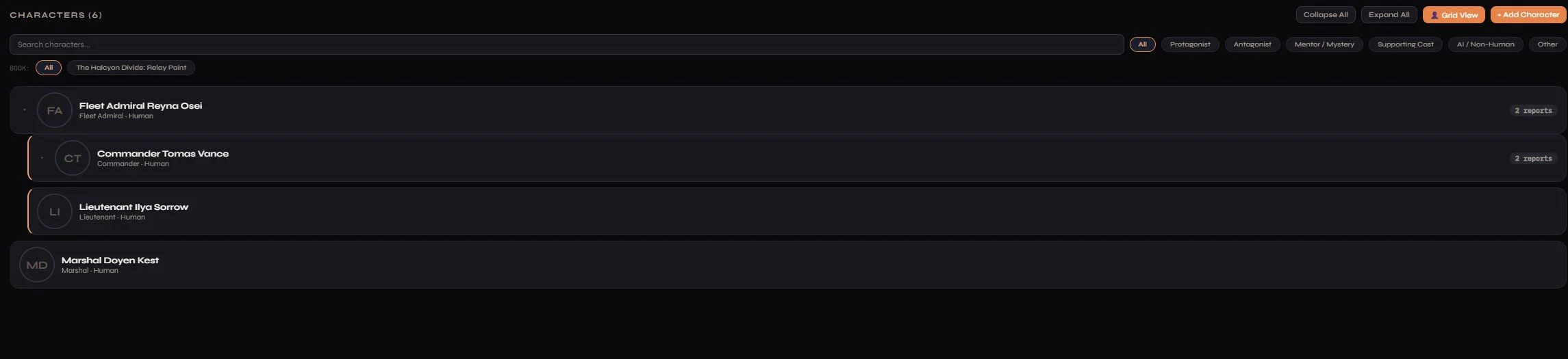
Characters — full profiles, photos, role tagging, and relationships across every book, with rank and reports-to structure pulled straight from your factions and governments
Chain of Command — collapsible org charts for every faction and government, so your military hierarchy or royal court structure is visual, not just a list
Worlds — locations, species, factions, languages, history, rituals, food & beverage, flora — as deep as your story needs
Magic & Combat — full catalogues for systems, weapons, and equipment
Books & Plot — track every volume, status, themes, and plot points
StoryBoard — a drag-and-drop scene tracker, five columns from Placeholder to Cut, so you see your whole manuscript's shape at a glance instead of scrolling a linear outline
Plot Threads — color-code a throughline, tag it to scenes, then filter down to just that one, so a subplot never goes quiet for six chapters without you noticing
Consistency Report — flags contradictions across your world before a reader (or an agent) finds them first
Global Search & Find/Replace — locate or fix anything in your world in seconds, not scrolls Custom Field Registry — add your own fields to any module, world-wide, without waiting on an update
Submission Tracker — a timeline-based tracker for agents, magazines, contests, and anthologies, with direct CSV import from QueryTracker.net
World Summary Export — generate a clean, shareable document from your world data, ready to hand to a co-writer, editor, or your future self
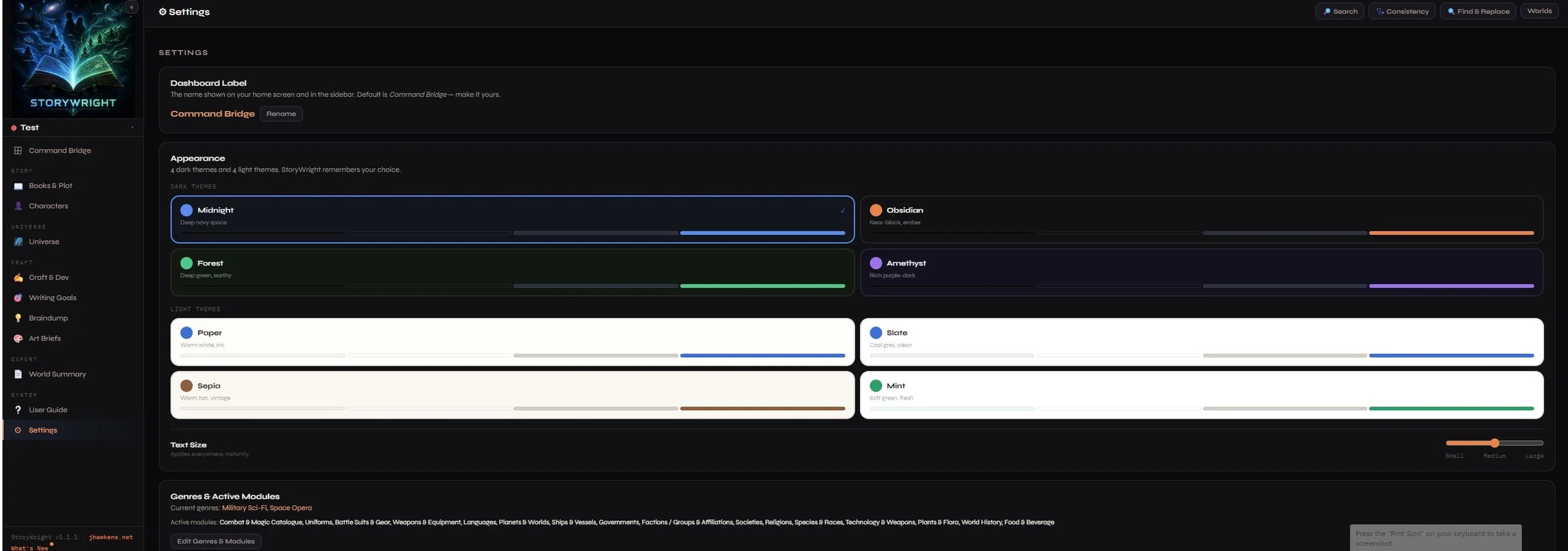
Genre-Aware Modules — only the fields your story actually needs show up; a romance writer never wades through spaceship specs
This is StoryWright in action.
Open the file and the Command Bridge gives you an instant snapshot of your entire universe — characters, books, factions, word count, all in one place. From there, every character gets a full profile, tagged by role and linked directly to the books they appear in, so nothing about your story lives in a separate, disconnected document ever again.
It's not a one-size-fits-all layout, either. Under Settings, you pick your genre, and StoryWright shows only the fields that genre actually needs — then lets you add your own custom fields on top. The tool adapts to your world. Not the other way around.